
Pay-per-click advertising has a reputation for being expensive. Many businesses launch campaigns, watch their budget disappear, and wonder why the leads never arrive.
The problem usually is not PPC itself.
It is how the campaign was built.
A profitable PPC campaign does not happen by accident. It requires strategy, audience research, compelling ad copy, smart bidding, and continuous optimization. When all those elements work together, PPC can become one of the fastest ways to generate qualified leads and revenue.
Many businesses make the mistake of treating PPC like a vending machine. They put money in and expect customers to come out. Unfortunately, digital advertising does not work that way.
Successful advertisers understand that every click represents a real person making a decision. Your job is to guide that person from curiosity to conversion.
Whether you’re running ads for a local company, an ecommerce store, or a B2B service provider, understanding the fundamentals can save thousands of dollars in wasted spend.
This guide breaks down the essentials of building profitable PPC campaigns from the ground up.
What Is PPC Advertising?
PPC, or pay-per-click advertising, is a digital marketing model where advertisers pay a fee each time someone clicks their ad.
The most common PPC platform is Google Ads, but businesses also advertise on platforms such as:
- Google Search
- Google Display Network
- YouTube
- Microsoft Ads
- TikTok
The concept sounds simple. You create an ad, target an audience, and pay when someone clicks.
The reality is more complex.
Every search query enters an auction. Advertisers compete for visibility, but the highest bidder does not always win. Platforms also evaluate ad quality, relevance, and expected user experience.
That is why a smaller company can sometimes outperform a competitor with a much larger budget.
Why PPC Remains One of the Fastest Growth Channels
SEO is powerful, but it often takes months to generate significant traffic.
PPC delivers visibility immediately.
A well-structured campaign can begin generating leads within hours of launch. That speed makes PPC attractive for businesses that need results quickly.
Consider a local roofing company.
Waiting six months for organic rankings may not be practical. Running targeted search ads for homeowners actively searching for roofing services can generate qualified inquiries almost immediately.
The same principle applies to law firms, healthcare providers, software companies, and ecommerce brands.
People searching for solutions already have intent.
PPC allows you to appear in front of them at the exact moment they are looking.
Understanding Search Intent
One of the biggest mistakes beginners make is targeting keywords without understanding intent.
Not all searches are equal.
Someone searching “what is PPC advertising” is likely researching.
Someone searching “PPC management services near me” is much closer to making a purchase decision.
These represent completely different audiences.
Generally, search intent falls into three categories:
Informational Intent
Users want information.
Examples include:
- What is PPC advertising
- How does Google Ads work
- PPC campaign examples
These keywords are useful for content marketing but may not generate immediate conversions.
Commercial Intent
Users are evaluating options.
Examples include:
- Best PPC agencies
- PPC software comparison
- Google Ads management pricing
These searches often indicate future buying potential.
Transactional Intent
Users are ready to act.
Examples include:
- Hire PPC agency
- PPC management company
- Google Ads consultant
These keywords typically produce the highest conversion rates.
Understanding intent helps determine where advertising dollars should go.
Keyword Research: The Foundation of Profitability
Many advertisers focus on traffic volume.
Experienced marketers focus on conversion potential.
A keyword generating 10,000 monthly searches may seem attractive, but if it rarely converts, it becomes expensive noise.
Meanwhile, a keyword with only 200 monthly searches might produce a steady stream of qualified leads.
Start by identifying:
- Core services
- Customer pain points
- Purchase-driven searches
- Location-specific opportunities
Tools like Google Keyword Planner can reveal valuable opportunities.
Look beyond obvious keywords.
For example, a business offering marketing services might target terms related to lead generation, customer acquisition, or advertising strategy rather than broad industry phrases alone.
The goal is finding searches connected to real business outcomes.
Structuring Campaigns the Right Way
Campaign structure has a direct impact on performance.
A common beginner mistake is placing dozens of unrelated keywords into a single ad group.
This creates relevance problems.
Imagine an ad group containing:
- PPC management
- SEO services
- Social media marketing
- Website design
Creating a single ad that speaks effectively to all four services becomes nearly impossible.
Instead, organize campaigns by themes.
Campaign Level
Separate campaigns based on goals, services, or locations.
Examples:
- Search Campaign
- Brand Campaign
- Lead Generation Campaign
- Remarketing Campaign
Ad Group Level
Create tightly focused ad groups.
Examples:
- Google Ads Management
- PPC Audits
- Ecommerce PPC
- Local PPC Services
This approach improves quality scores and often lowers advertising costs.
Writing Ads That Actually Get Clicks

Great ads balance relevance and persuasion.
Many advertisers focus only on features.
Customers care more about outcomes.
Compare these examples.
Weak headline:
“PPC Management Services”
Stronger headline:
“Reduce Wasted Ad Spend and Increase Qualified Leads”
The second version addresses a business problem.
That difference matters.
Strong PPC ads often include:
- Clear value proposition
- Specific benefits
- Action-oriented language
- Trust indicators
- Relevant keywords
Now, here’s the interesting part.
The best-performing ads are not always the most creative.
They are often the most relevant.
Users respond to ads that closely match what they searched.
Landing Pages Matter More Than Most People Think
An effective ad can still fail if it sends visitors to a poor landing page.
Imagine clicking an ad promoting a free consultation.
You arrive on a homepage with dozens of navigation links, multiple services, and no clear next step.
Most visitors leave.
A strong landing page focuses on a single objective.
It should include:
- Clear headline
- Supporting benefits
- Trust signals
- Testimonials
- Strong call-to-action
- Mobile-friendly design
Every additional distraction reduces conversion potential.
Think of a landing page like a guided conversation.
The easier the path, the higher the conversion rate.
Smart Budgeting for New Campaigns
One question comes up frequently.
How much should you spend?
There is no universal answer.
The budget depends on industry competition, customer value, and campaign objectives.
However, beginners should avoid two extremes.
The first is spending too little.
A campaign with insufficient data makes optimization difficult.
The second is spending aggressively before understanding performance metrics.
Start with a manageable budget.
Gather data.
Analyze results.
Then scale what works.
This approach reduces risk while creating opportunities for growth.
The Metrics That Actually Matter
Many beginners obsess over clicks.
Clicks alone do not pay the bills.
Instead, focus on metrics tied to business outcomes.
Conversion Rate
Measures how many visitors complete a desired action.
Higher conversion rates generally indicate stronger campaign performance.
Cost Per Conversion
Shows how much it costs to generate a lead or sale.
This metric often reveals profitability faster than traffic numbers.
Return on Ad Spend
ROAS measures revenue generated compared to advertising costs.
A campaign producing $5,000 in revenue from a $1,000 spend delivers a 5:1 ROAS.
Quality Score
Google evaluates ad relevance, expected click-through rate, and landing page experience.
Higher quality scores often reduce costs.
The most successful advertisers watch these metrics closely.
How AI Is Changing PPC Management
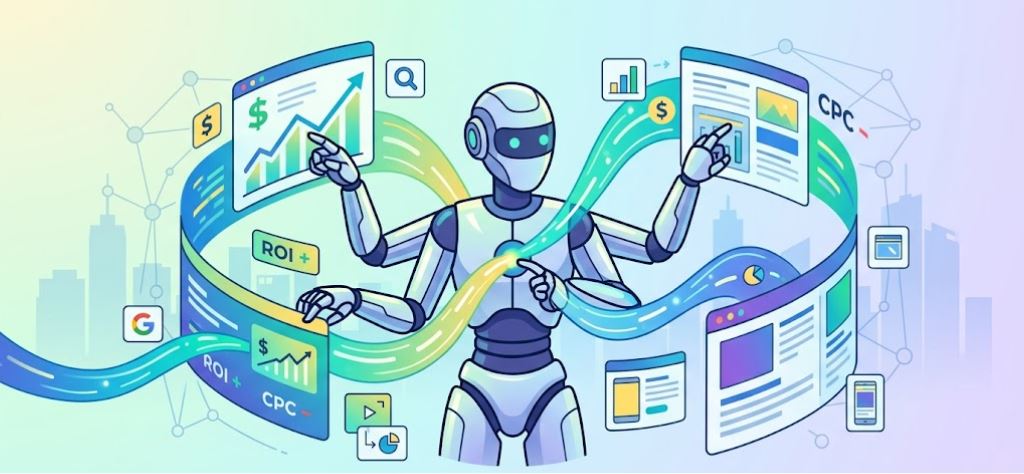
Artificial intelligence has become a major force in paid advertising.
Google’s Smart Bidding systems now analyze thousands of signals in real time.
These systems evaluate:
- Device type
- User behavior
- Search context
- Geographic location
- Historical performance
The result is more automated optimization.
However, AI is not a replacement for strategy.
It still requires human oversight.
Businesses often assume automation means they can ignore campaign management.
That assumption can become expensive.
The strongest results come from combining human expertise with AI-powered tools.
Many businesses working with a digital marketing agency in Los Angeles choose agencies that understand both automation and strategic decision-making. Technology handles the calculations. Experienced marketers provide the direction.
Common PPC Mistakes to Avoid
Some mistakes appear repeatedly across industries.
Avoiding them can dramatically improve results.
Ignoring Negative Keywords
Negative keywords prevent ads from appearing for irrelevant searches.
Without them, budgets disappear quickly.
Sending Traffic to Homepages
Generic homepages rarely convert as effectively as dedicated landing pages.
Making Changes Too Frequently
Optimization requires data.
Changing campaigns daily often creates confusion rather than improvement.
Focusing Only on Traffic
High traffic means little without conversions.
Revenue should remain the primary goal.
Neglecting Mobile Users
Most searches now happen on mobile devices.
A poor mobile experience can destroy performance.
A Practical Example
Imagine a local accounting firm launching Google Ads.
Instead of targeting broad keywords like “accounting,” they focus on:
- Small business accountant
- Tax preparation services
- CPA consultation
They create separate landing pages for each service.
Their ads highlight specific benefits.
They implement conversion tracking from day one.
After several weeks, they identify which keywords generate consultations.
Budget shifts toward top performers.
Underperforming keywords are paused.
This is how profitable campaigns evolve.
Not through luck.
Through continuous refinement.
Scaling a Campaign Successfully
Once a campaign becomes profitable, the next challenge is growth.
Scaling should be methodical.
Expand by:
- Increasing budgets gradually
- Testing new keywords
- Creating additional ad variations
- Exploring remarketing campaigns
- Expanding geographic targeting
The key is maintaining efficiency while increasing volume.
Rapid scaling without monitoring performance often leads to declining returns.
Steady growth typically wins.
The Human Side of PPC
Numbers matter.
Data matters.
Technology matters.
Yet profitable PPC campaigns still revolve around people.
Behind every search is a person trying to solve a problem.
The most successful advertisers understand that reality.
They focus less on algorithms and more on customer motivations.
Why is someone searching?
What challenge are they facing?
What information do they need before taking action?
Answering those questions often produces better results than any bidding strategy.
Conclusion
Profitable PPC campaigns are built on fundamentals.
Strong keyword research, clear campaign structure, persuasive ad copy, and high-converting landing pages form the foundation. Smart budgeting, data-driven optimization, and thoughtful use of AI strengthen performance over time.
Many businesses struggle with PPC because they focus on clicks rather than outcomes. The goal is not traffic. The goal is profitable growth.
When approached strategically, PPC becomes far more than an advertising channel. It becomes a predictable system for generating leads, acquiring customers, and scaling revenue.
The platforms will continue evolving. AI will continue reshaping campaign management. Consumer behavior will continue changing.
The fundamentals, however, remain remarkably consistent.
Understand your audience. Deliver relevant messages. Measure what matters. Improve continuously.
That formula still works—and it likely will for years to come.
Frequently Asked Questions
How much should a beginner spend on a PPC campaign?
There is no universal budget that works for every business. A good starting point is an amount that generates enough data for analysis. Many small businesses begin with a few hundred to a few thousand dollars per month, depending on their industry and competition. The goal is to gather meaningful performance data before increasing spending.
How long does it take for a PPC campaign to become profitable?
Some campaigns generate positive results within days, while others require several weeks of optimization. Factors such as keyword selection, landing page quality, competition, and bidding strategy all influence performance. Most advertisers need at least a few weeks of data before making informed optimization decisions.
What is the difference between PPC and SEO?
PPC delivers immediate visibility through paid advertisements, while SEO focuses on earning organic rankings in search results. PPC can generate traffic as soon as a campaign launches. SEO typically requires more time but can provide long-term traffic without paying for every click. Many successful businesses use both strategies together.
Which PPC platform is best for beginners?
Google Ads is often the best starting point because it reaches users actively searching for products and services. Businesses can target customers based on specific keywords and search intent. Depending on the audience, platforms such as Microsoft Ads, LinkedIn Ads, Facebook Ads, and Instagram Ads may also be effective.
What are negative keywords in PPC advertising?
Negative keywords prevent ads from appearing for irrelevant searches. For example, a company offering premium consulting services may exclude terms such as “free” or “cheap.” Using negative keywords helps reduce wasted ad spend and improves overall campaign efficiency.
Why are landing pages important for PPC campaigns?
Landing pages play a major role in conversion rates. Even a highly effective ad can underperform if visitors arrive on a confusing or irrelevant page. A focused landing page with a clear message, strong call-to-action, and relevant content often converts significantly better than a general homepage.
Can AI improve PPC campaign performance?
Yes. AI-powered bidding strategies can analyze large amounts of data and adjust bids in real time. These tools help advertisers optimize for conversions, leads, and revenue. However, AI works best when paired with human oversight, strategic planning, and ongoing campaign management.
Should businesses hire a PPC agency or manage campaigns in-house?
The answer depends on available expertise, time, and advertising budget. Businesses with experienced marketing teams may successfully manage campaigns internally. Others may benefit from working with professionals who understand campaign strategy, optimization, tracking, and performance analysis. The right approach depends on business goals and resources.