Pay-per-click advertising has always been a balancing act.
Marketers want more conversions, lower costs, and better targeting. Yet every campaign faces the same challenge: reaching the right person at the right moment without wasting budget.
Not long ago, PPC success depended heavily on manual work. Marketers spent hours analyzing search terms, adjusting bids, creating audience segments, and testing ad variations. The process worked, but it was time-consuming and often reactive rather than proactive.
Today, AI is changing that equation.
Modern PPC platforms can process millions of data points in seconds. They identify patterns that would take humans weeks to uncover. More importantly, they help advertisers make better decisions before performance starts to decline.
This shift is one reason businesses are investing heavily in AI-driven marketing solutions. According to Statista, the global AI market is expected to surpass $800 billion by 2030. Marketing remains one of the fastest-growing areas of adoption because AI directly impacts revenue-generating activities.
For PPC advertisers, the benefits are becoming difficult to ignore.
AI can predict conversion likelihood, automate bidding strategies, identify valuable audience segments, and even generate ad creative. The result is improved efficiency and stronger returns on advertising spend.
However, simply turning on AI features does not guarantee success.
The most successful advertisers understand where AI creates value and where human expertise still matters. Technology can process data, but marketers provide strategy, creativity, and business context.
In this article, we’ll explore the AI tools transforming PPC advertising, how they improve targeting and ROI, and what businesses should consider before integrating them into their campaigns.
Why PPC Campaigns Need AI
The average consumer interacts with dozens of digital touchpoints before making a purchase.
Someone might discover a brand through social media, research products through search engines, read reviews, compare competitors, and then finally convert days later.
Tracking and optimizing these journeys manually has become increasingly difficult.
Consider a retailer running campaigns across Google Ads, Microsoft Ads, Meta, LinkedIn, and YouTube. Each platform generates thousands of data points daily.
Now imagine trying to manually identify:
- Which audience segments convert best
- Which keywords drive revenue
- Which ads influence conversions
- Which bid adjustments improve performance
The workload quickly becomes overwhelming.
AI helps marketers process these variables simultaneously. Instead of reacting to yesterday’s data, campaigns can adapt in near real time.
The result is smarter targeting and better budget allocation.
How AI Improves PPC Targeting
Audience Discovery Beyond Traditional Segmentation
Traditional targeting relies on demographic information such as age, location, and interests.
AI goes much deeper.
Machine learning algorithms analyze user behavior, browsing patterns, engagement signals, purchase history, and intent indicators.
This creates more sophisticated audience profiles.
For example, two users may appear identical on paper. Both are 35 years old and live in the same city. However, AI might recognize that one frequently researches software solutions while the other primarily consumes entertainment content.
That distinction can significantly impact ad performance.
Platforms like Google Ads use machine learning to identify high-intent users who are most likely to convert.
Predictive Customer Intent
One of AI’s biggest advantages is prediction.
Instead of waiting for users to convert, AI estimates the likelihood of conversion before it happens.
This allows advertisers to prioritize high-value opportunities.
A B2B software company, for instance, might discover that visitors who read pricing pages, attend webinars, and return multiple times convert at significantly higher rates.
AI identifies these patterns automatically and increases bidding aggressiveness when similar users appear.
The outcome is often better conversion rates without increasing overall spend.
Real-Time Behavioral Analysis
Consumer behavior changes constantly.
Seasonality, market conditions, competitor promotions, and even news events influence buying decisions.
AI continuously evaluates performance signals and adjusts targeting accordingly.
Rather than relying on static audience lists, campaigns evolve based on current user behavior.
This flexibility helps advertisers stay competitive in rapidly changing markets.
AI-Powered Bidding Tools That Improve ROI
Google Smart Bidding
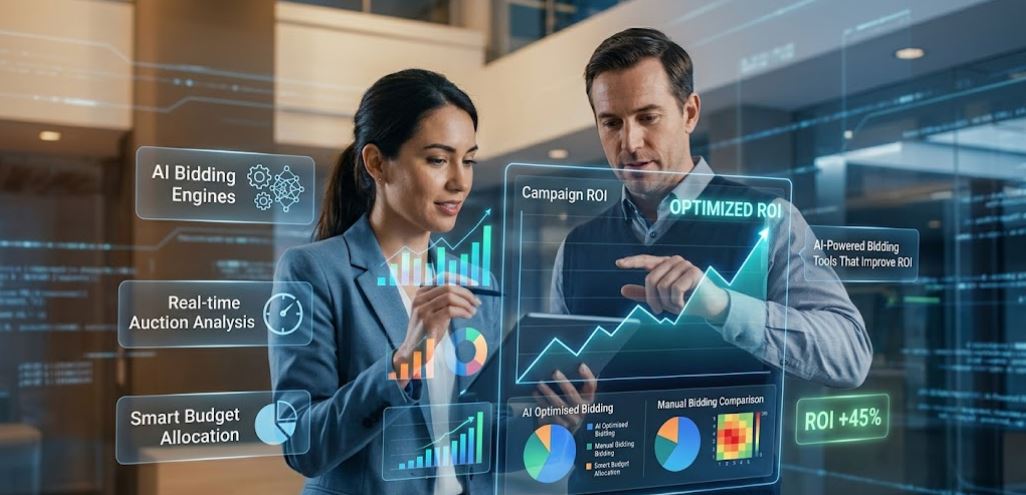
Google Smart Bidding remains one of the most widely adopted AI tools in PPC.
The platform evaluates countless signals during every auction, including:
- Device type
- Location
- Time of day
- Search intent
- User behavior
- Historical conversion patterns
The system automatically adjusts bids to maximize desired outcomes.
Many advertisers initially hesitate to surrender manual control. Yet numerous studies have shown that Smart Bidding frequently outperforms manual bidding when campaigns have sufficient conversion data.
The key is proper implementation.
Poor tracking leads to poor AI decisions.
Target ROAS Optimization
Return on ad spend remains one of the most important PPC metrics.
AI-driven Target ROAS strategies focus on maximizing revenue rather than simply increasing conversions.
This distinction matters.
Not all conversions have equal value.
An ecommerce store selling premium products may prefer fewer high-value purchases over dozens of low-value transactions.
AI evaluates historical purchasing behavior and adjusts bids based on expected revenue contribution.
Budget Allocation Across Campaigns
One common PPC problem involves budget inefficiency.
Some campaigns exhaust budgets too early while others underspend despite strong performance.
AI tools help solve this issue by distributing spend toward the highest-performing opportunities.
Rather than relying on manual adjustments, advertisers can allocate resources dynamically based on actual performance data.
AI Tools for Ad Creative Optimization
Responsive Search Ads
Creating effective ad copy has traditionally required extensive testing.
Marketers write multiple headlines and descriptions, then wait for performance data to identify winners.
AI accelerates this process.
Google’s Responsive Search Ads allow advertisers to provide multiple headline and description options.
Machine learning automatically assembles combinations and identifies the strongest performers.
The process continuously improves over time.
Generative AI for Ad Creation
Generative AI tools are becoming increasingly valuable for PPC teams.
These systems help create:
- Ad headlines
- Descriptions
- Landing page copy
- Call-to-action variations
- Display ad content
Now, here’s the interesting part.
The best-performing campaigns rarely rely entirely on AI-generated copy.
Instead, marketers use AI as a starting point and apply human refinement afterward.
This combination often delivers stronger results than either approach alone.
Real-World Example: Google Performance Max
Performance Max campaigns represent one of Google’s most advanced AI advertising solutions.
Rather than managing separate campaigns across Search, Display, YouTube, Discover, and Gmail, advertisers provide creative assets and conversion goals.
Google’s AI handles targeting, placements, bidding, and optimization.
Many ecommerce businesses have reported increased conversion volume after implementing Performance Max campaigns alongside traditional search campaigns.
However, success often depends on providing high-quality creative assets and accurate conversion tracking.
The AI is only as effective as the data it receives.
Real-World Example: Meta Advantage+ Campaigns
Meta introduced Advantage+ campaigns to simplify campaign management using AI.
The platform automates audience targeting, creative delivery, and budget allocation.
Instead of manually building detailed audience segments, advertisers focus on business goals.
Meta’s algorithms identify users most likely to convert.
Several ecommerce brands have reported lower acquisition costs through Advantage+ campaigns, particularly when targeting broad audiences.
The lesson is clear.
AI often performs best when given room to discover opportunities beyond traditional targeting assumptions.
Where Human Expertise Still Matters
AI can optimize campaigns.
It cannot replace strategic thinking.
Marketers still play critical roles in:
- Defining campaign objectives
- Developing messaging
- Understanding customer motivations
- Evaluating business priorities
- Managing budgets strategically
A machine might recognize patterns.
It cannot fully understand brand positioning, market nuances, or long-term business goals.
This is why businesses often partner with a digital marketing agency in Pasadena that combines AI capabilities with experienced PPC management.
Technology improves execution, but strategy drives outcomes.
Common Mistakes When Using AI for PPC
Relying on Automation Too Soon
AI needs data.
Launching automated strategies without sufficient conversion history often produces inconsistent results.
Ignoring Conversion Tracking
Poor tracking creates poor optimization.
Every AI system depends on accurate data collection.
Eliminating Human Oversight
Automation should support decision-making, not replace it entirely.
Regular reviews remain essential.
Focusing Only on Efficiency Metrics
Lower costs are valuable.
However, profitability and business growth should remain the primary objectives.
How Businesses Can Get Started
Organizations interested in AI-powered PPC should begin gradually.
Start by:
- Implementing accurate conversion tracking.
- Testing automated bidding strategies.
- Using AI-assisted audience targeting.
- Evaluating performance consistently.
- Combining automation with human expertise.
Over time, businesses can expand AI adoption as confidence and data maturity increase.
The Future of AI-Powered PPC
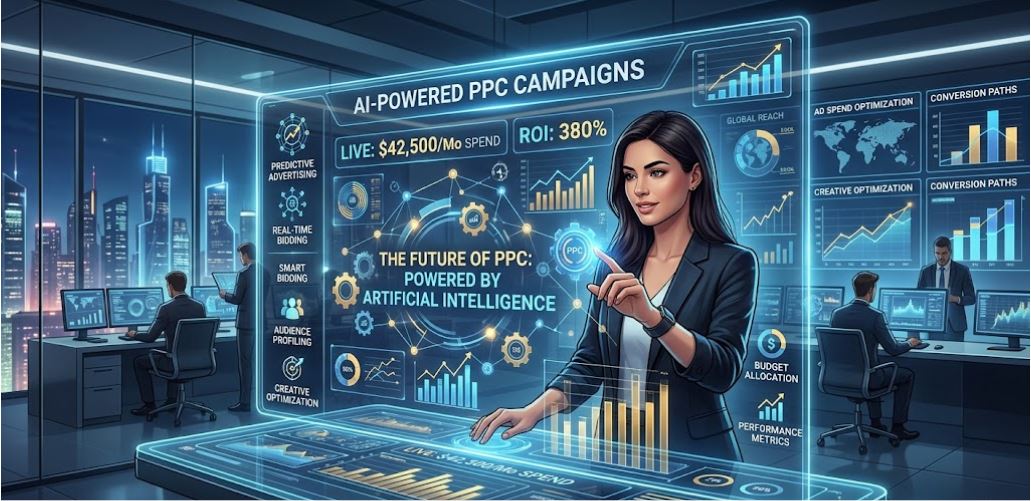
The next generation of PPC advertising will become increasingly predictive.
AI systems will better understand customer intent, automate campaign management, and personalize experiences at scale.
Advertisers who embrace these capabilities now will likely gain competitive advantages.
That doesn’t mean marketers become less important.
In many ways, their role becomes more valuable.
As automation handles execution, marketers can focus on strategy, creativity, and customer understanding.
The companies that balance both elements effectively will see the strongest returns.
Conclusion
AI is reshaping PPC advertising in meaningful ways.
From audience targeting and bid optimization to creative testing and budget allocation, AI tools help marketers make smarter decisions faster.
The technology delivers impressive efficiencies, but it works best when paired with human expertise.
Businesses that combine strategic thinking with AI-powered optimization can improve targeting, reduce wasted spend, and generate stronger ROI.
The future of PPC isn’t human versus machine.
It’s a human strategy enhanced by intelligent automation.
Frequently Asked Questions
How does AI improve PPC targeting?
AI analyzes user behavior, intent signals, demographics, and historical data to identify audiences most likely to convert. This leads to more accurate targeting and less wasted ad spend.
Which AI tools are commonly used in PPC advertising?
Popular tools include Google Smart Bidding, Performance Max, Meta Advantage+, Microsoft Advertising AI features, and various AI-powered analytics platforms.
Can AI reduce PPC costs?
Yes. AI can improve bidding efficiency, optimize audience targeting, and identify underperforming segments. These improvements often lower cost per acquisition.
Is AI replacing PPC specialists?
No. AI automates many tactical tasks, but marketers still provide strategy, creative direction, business context, and campaign oversight.
Should small businesses use AI for PPC campaigns?
Absolutely. Many AI-powered features are built directly into advertising platforms, making them accessible to businesses of all sizes.
How can a digital marketing agency in Pasadena help with AI-powered PPC?
An experienced agency can implement AI tools correctly, ensure accurate tracking, develop strategic campaigns, and interpret performance data to maximize return on investment.