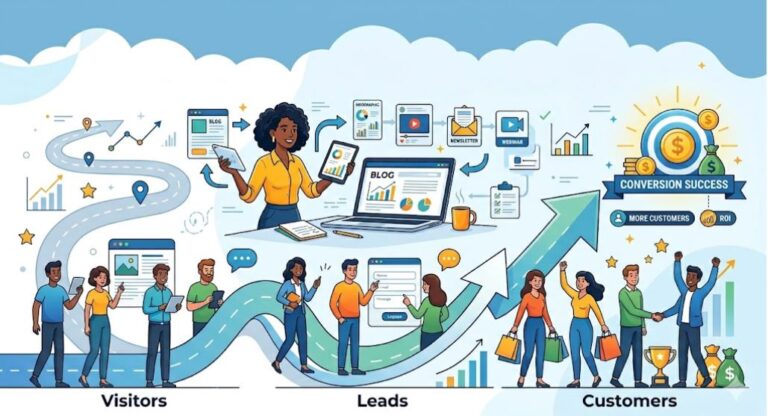
A beautiful website can grab attention. A high-converting website does something far more valuable—it persuades people to act.
That difference matters. Businesses often spend months perfecting colors, typography, and animations, only to wonder why leads remain flat. The issue usually isn’t aesthetics. It’s strategy.
Every page should guide visitors toward a decision. Whether someone books a consultation, requests a quote, or makes a purchase, good web design removes uncertainty instead of creating it. Great designers understand psychology as much as they understand layout.
This shift has become even more important as AI transforms digital marketing. Businesses now use AI-powered analytics, personalization tools, predictive customer insights, and automated testing to understand visitor behavior faster than ever before. Yet AI alone won’t fix a confusing website. Technology only amplifies a strong strategy.
For companies investing in modern marketing, web design should never operate in isolation. It should work alongside SEO, content strategy, conversion optimization, and intelligent automation to create experiences customers actually enjoy.
Great Web Design Is More Than Looking Modern
Think about the last time you landed on a cluttered website.
The navigation felt confusing. Pop-ups appeared before you finished reading the headline. The page loaded slowly. Within seconds, you were gone.
Most people behave exactly the same way.
Visitors form opinions about websites almost instantly. Once trust disappears, earning it back becomes difficult. Every design choice either builds confidence or creates friction.
That’s why successful brands rarely chase design trends for the sake of appearing trendy. Instead, they ask a different question:
“Will this make the customer’s journey easier?”
That mindset separates websites that generate leads from those that simply collect page views.
Google has repeatedly emphasized that speed directly affects user experience. Research also shows that when page load time increases from one second to ten seconds, the probability of a visitor leaving rises dramatically.
Now, here’s the interesting part.
Many businesses still believe conversion optimization starts with changing button colors or rewriting headlines. Those tactics can help, but they’re rarely the biggest factor.
The real opportunity lies in designing an experience that feels effortless.
What Makes a Website Convert?
Conversion happens when visitors trust what they see.
Trust isn’t created through one feature. It’s built through dozens of small moments working together.
Imagine walking into two retail stores.
One store is brightly lit, organized, and easy to navigate. Staff members greet you naturally, products are clearly labeled, and checkout is simple.
The second store feels cramped. Signs point in different directions. Employees are difficult to find. Products seem randomly placed.
Both stores sell the same products.
Most people instinctively choose the first.
Websites work the same way.
Good design quietly removes obstacles before visitors even notice them.
Some of the strongest conversion-focused websites consistently deliver these qualities:
- Clear messaging above the fold
- Simple navigation
- Fast performance
- Mobile-friendly layouts
- Strong visual hierarchy
- Visible trust signals
- Obvious calls to action
None of these ideas are revolutionary. Their strength comes from execution.
Start With Visual Hierarchy
Visitors don’t read websites from top to bottom.
They scan.
Eye-tracking studies have shown that users naturally focus on certain areas before deciding where to look next. Good visual hierarchy guides those movements instead of leaving them to chance.
Start with one clear headline.
Support it with a concise explanation.
Then present one primary action.
Many businesses accidentally overwhelm visitors by trying to promote everything at once.
“We build websites, offer SEO, or manage PPC.”
Suddenly the homepage becomes a billboard instead of a conversation.
A better approach focuses attention.
Apple remains one of the strongest examples of this philosophy. Product pages typically highlight one key message before introducing supporting information. Images reinforce the story rather than compete with it.
Visitors never wonder where to look next.
That’s intentional.
Mobile Design Isn’t Optional
More people browse on smartphones than desktops.
That changes everything.
A desktop layout that looks impressive can become frustrating on a smaller screen if designers don’t rethink spacing, navigation, and content flow.
Buttons should remain easy to tap.
Forms should require minimal typing.
Images should scale naturally.
Navigation menus should simplify—not hide—important information.
Google’s research has consistently shown how strongly mobile performance affects engagement. Slow experiences lead to abandoned visits long before users explore your content.
Businesses sometimes treat mobile optimization as the final project phase.
That’s backwards.
Modern websites should begin with mobile experiences first, then expand naturally for larger screens.
Speed Shapes First Impressions
Here’s a simple exercise.
Open two competing websites.
If one loads instantly while the other hesitates for several seconds, which business feels more professional?
Most people answer without thinking.
Website speed communicates competence.
Even if visitors can’t explain why, fast experiences create confidence.
Google’s research found that as mobile pages become slower, bounce rates increase substantially. Additional page complexity can also reduce conversions.
Fortunately, improving speed doesn’t always require rebuilding an entire website.
Often, the biggest improvements come from practical decisions:
- Compress large images.
- Remove unnecessary plugins.
- Minimize excessive animations.
- Reduce unused scripts.
- Choose reliable hosting.
- Optimize Core Web Vitals.
These technical improvements may seem invisible.
Customers notice them anyway.
Every Call-to-Action Should Answer “What’s Next?”
Many websites use generic buttons like:
- Learn More
- Submit
- Click Here
- Read More
They’re familiar.
They’re also forgettable.
Strong calls-to-action reduce uncertainty.
Compare these examples:
Generic
“Contact Us”
Specific
“Schedule Your Free Website Audit”
The second tells visitors exactly what happens next.
That small difference often improves conversions because people prefer clarity over curiosity.
Context matters too.
A pricing page may encourage someone to request a proposal.
A blog article might invite readers to download a guide.
A homepage could encourage booking a consultation.
Each CTA should match where visitors are in their decision-making process.
Build Trust Before Asking for Business
Imagine meeting a salesperson who immediately asks for your credit card.
You’d probably walk away.
Many websites unintentionally do the digital equivalent.
They ask visitors to commit before establishing credibility.
Trust develops through consistent signals.
Customer testimonials.
Verified reviews.
Case studies.
Industry certifications.
Security badges.
Recognizable client logos.
Clear contact information.
Transparent pricing when appropriate.
These elements reassure visitors that real people stand behind the business.
For example, software companies like Shopify showcase customer success stories throughout their website rather than hiding them on a separate page. Those stories reinforce confidence exactly when potential customers begin evaluating the platform.
Trust shouldn’t feel like an afterthought.
It should be woven throughout the entire experience.
Web Design Works Best When Marketing Drives Every Decision
The most attractive website won’t generate results if nobody finds it.
Likewise, strong SEO can’t compensate for confusing user experiences.
That’s why successful businesses increasingly connect web design with search optimization, content marketing, AI-powered analytics, and conversion tracking.
Instead of treating design as a creative project alone, they treat it as part of a complete growth strategy.
For businesses searching for a digital marketing agency in Pasadena, this integrated approach often delivers stronger long-term results than redesigning a website based solely on appearance. Every design decision should support measurable business goals, from increasing qualified leads to improving customer retention.
Use AI to Create More Personalized Web Experiences
Artificial intelligence has changed how businesses approach web design.
A few years ago, improving a website often relied on intuition. Designers made educated guesses, launched updates, and waited weeks to see the results.
Today, AI shortens that cycle.
Modern tools analyze visitor behavior, identify friction points, predict user intent, and even recommend layout improvements based on real interactions. Instead of relying solely on assumptions, marketers can make informed decisions backed by data.
That doesn’t mean AI replaces designers.
It gives them better information.
For example, AI-powered heatmaps reveal where users click, pause, or abandon a page. Predictive analytics highlight which visitors are most likely to convert. Personalization platforms adjust content based on browsing behavior, location, or previous interactions.
Imagine two visitors arriving at the same homepage.
One is a returning customer looking for pricing.
The other is discovering your business for the first time.
Showing both visitors identical content isn’t always the best experience.
AI helps tailor those interactions without requiring businesses to create dozens of separate websites.
The result feels more relevant—and relevance often leads to higher conversions.
Balance Creativity With Usability
Designers naturally want to create something memorable.
There’s nothing wrong with originality.
Problems appear when creativity makes a website harder to use.
You’ve probably seen websites where menus disappear into animations, text blends into busy backgrounds, or scrolling triggers endless visual effects.
They certainly look impressive.
Finding basic information? Not so much.
The most successful websites rarely force visitors to learn how the interface works. Instead, they follow familiar design patterns while adding distinctive branding.
Research from the Baymard Institute continues to show that many websites struggle with navigation and information architecture, causing unnecessary confusion during the customer journey.
Good design should surprise people with your brand—not with how difficult your website is to navigate.
Content and Design Should Tell the Same Story
A beautifully designed website cannot rescue weak messaging.
Likewise, excellent copy loses its impact when buried inside poor layouts.
Design and content should work together.
Think of them as two people rowing the same boat.
If one rows faster than the other, progress slows.
Suppose your homepage promises faster business growth through AI-driven marketing.
Every supporting element should reinforce that promise.
Case studies should demonstrate measurable results.
Images should reflect modern business environments.
Calls-to-action should continue the conversation rather than interrupt it.
Even typography contributes.
Long paragraphs discourage reading.
Short, well-structured sections invite visitors to continue exploring.
Jakob Nielsen’s long-standing usability research found that people scan web pages instead of reading every word. That’s why concise, structured content consistently performs better online.
In other words, writing for websites isn’t about saying more.
It’s about making every sentence easier to find.
Common Web Design Mistakes That Reduce Conversions
Some conversion problems aren’t obvious until businesses examine user behavior.
These issues appear across industries, regardless of company size.
Watch for these common mistakes:
- Multiple competing calls-to-action on the same page.
- Slow-loading images and videos.
- Navigation menus with too many options.
- Walls of text without visual breaks.
- Contact forms asking for unnecessary information.
- Generic stock photography that feels impersonal.
- Inconsistent branding across pages.
- Hidden pricing or vague service descriptions.
Individually, these problems seem small.
Combined, they create friction.
And friction quietly lowers conversions.
One of the easiest ways to identify these issues is through usability testing. Ask someone unfamiliar with your business to complete a simple task, such as requesting a quote.
Then stay silent.
Watching where they hesitate often reveals more than months of internal discussions.
Real-World Example: Airbnb Simplified the Booking Experience
Airbnb didn’t become one of the world’s most recognized travel platforms through attractive photography alone.
Its success also comes from reducing decision fatigue.
Search filters are intuitive.
Property photos load quickly.
Pricing remains visible throughout the booking process.
Reviews appear exactly when travelers need reassurance.
The platform removes uncertainty step by step instead of overwhelming users with information.
Each improvement may seem minor.
Together, they create a booking experience that feels natural.
That’s an important lesson for businesses of any size.
Visitors don’t evaluate isolated design features.
They remember the overall experience.
A Practical Scenario
Imagine a regional home services company investing in paid advertising.
Traffic increases every month.
Leads don’t.
After reviewing the website, several problems become obvious.
The homepage contains four competing offers.
The contact form asks for twelve fields.
Service pages lack customer testimonials.
Mobile users struggle to navigate dropdown menus.
None of these issues require a complete redesign.
Instead, the company simplifies navigation, shortens the contact form, improves page speed, adds customer reviews, and introduces AI-powered chat support that answers common questions instantly.
Within a few months, more visitors began completing inquiries—not because advertising improved, but because the website finally supported the marketing campaign.
That’s a common story.
Marketing attracts visitors.
Web design determines whether they stay.
Measure What Actually Matters
Many businesses celebrate growing traffic.
Traffic matters.
Conversions matter more.
A website should be evaluated through meaningful business metrics, including:
- Conversion rate
- Bounce rate
- Average engagement time
- Form completion rate
- Cost per acquisition
- Lead quality
- Returning visitor rate
AI-powered analytics platforms make identifying patterns much easier.
Instead of reviewing dozens of spreadsheets, marketers can uncover trends automatically.
For example, AI might reveal that mobile visitors consistently abandon a pricing page after reaching a specific section.
Without that insight, businesses could spend months optimizing the wrong elements.
Data removes guesswork.
Experience helps interpret the results.
Together, they create smarter decisions.
Great Web Design Is Never Finished
One misconception continues to slow digital growth.
Businesses launch a new website and consider the project complete.
In reality, launching should mark the beginning.
Customer expectations evolve.
Search engines update ranking signals.
Competitors introduce better experiences.
Technology advances rapidly.
Successful companies continuously refine their websites using analytics, customer feedback, usability testing, SEO insights, and AI-driven recommendations.
Small improvements made consistently often outperform dramatic redesigns every five years.
The websites generating the strongest business results today rarely became successful overnight.
They improved steadily.
Final Thoughts
A stunning website should do more than impress visitors.
It should guide them naturally toward action.
Every design decision—from page speed and navigation to messaging and trust signals—shapes how customers perceive your brand. When combined with AI-powered insights, businesses can move beyond assumptions and build experiences based on real user behavior.
The goal isn’t to create the flashiest website in your industry.
It’s to create the easiest one to use.
When web design aligns with SEO, content strategy, conversion optimization, and intelligent automation, it becomes far more than a digital brochure. It becomes one of your most effective marketing assets.
Businesses that embrace this mindset position themselves for long-term growth, stronger customer relationships, and higher returns from every marketing campaign.
Frequently Asked Questions
What makes a web design convert visitors into customers?
A high-converting website combines intuitive navigation, fast loading speeds, compelling calls-to-action, trust signals, and content that matches visitor intent. Every page should guide users toward a specific action with minimal friction.
How does AI improve web design?
AI analyzes user behavior, identifies conversion bottlenecks, personalizes content, predicts customer intent, and helps marketers optimize layouts using real-time insights rather than assumptions.
Why is mobile-first web design important?
Most users browse websites on mobile devices. A mobile-first approach ensures fast loading, readable content, intuitive navigation, and better user experiences across all screen sizes, which can improve both engagement and conversions.
How often should a business redesign its website?
Complete redesigns aren’t always necessary. Most businesses benefit from continuous improvements based on analytics, user feedback, SEO performance, and evolving customer expectations rather than waiting several years between updates.
Which metrics should businesses monitor after launching a website?
Focus on conversion rate, bounce rate, engagement time, form submissions, lead quality, returning visitors, and cost per acquisition. These metrics provide a clearer picture of business performance than traffic alone.
Can good web design improve SEO?
Yes. Fast-loading pages, mobile responsiveness, clear site architecture, and positive user experiences support SEO by helping search engines understand your website while encouraging visitors to stay longer and interact with your content.
Should businesses use AI instead of human designers?
No. AI works best as a decision-support tool. It provides valuable insights, automates analysis, and uncovers opportunities, while experienced designers and marketers apply creativity, strategic thinking, and business context to create websites that truly connect with customers.