Social media never really sleeps.
Your audience scrolls during breakfast, while waiting in line, during meetings, and late at night. Meanwhile, marketing teams face a different challenge. They need to create content, monitor engagement, analyze performance, respond to comments, and somehow publish posts at the right moment.
That is a lot to manage.
For years, social media scheduling tools helped marketers stay organized. They allowed teams to queue posts and maintain a consistent publishing calendar. However, scheduling alone is no longer enough. Competition for attention has become intense, algorithms change constantly, and audiences expect relevant content at exactly the right time.
This is where artificial intelligence is changing the conversation.
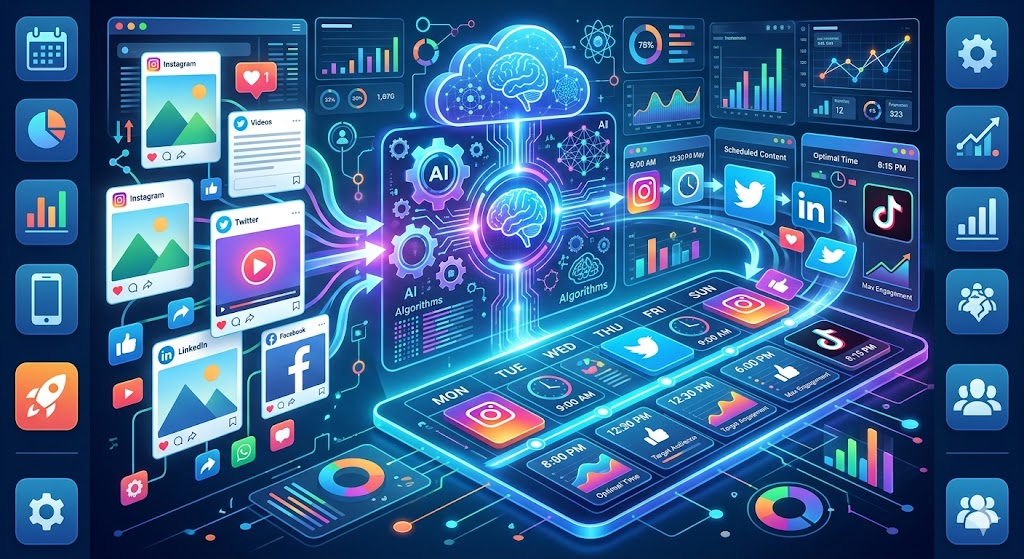
AI is helping businesses move beyond basic scheduling. Instead of simply deciding when a post goes live, AI can determine the best posting times, predict engagement levels, suggest content improvements, identify audience behavior patterns, and optimize campaigns in real time.
The result is a more efficient social media strategy backed by data rather than assumptions.
For businesses investing in digital marketing, AI-powered social media management is becoming less of a competitive advantage and more of an expectation.
The Evolution of Social Media Scheduling
Traditional scheduling tools solved one major problem: consistency.
Marketers could prepare content in advance and publish posts automatically throughout the week. This saved time and reduced the risk of missing important publishing windows.
Yet these tools had limitations.
Most scheduling decisions relied on historical assumptions. Teams often selected posting times based on general industry recommendations rather than audience-specific behavior.
For example, many marketers believed Tuesday mornings were ideal for engagement. While that may have been true for some audiences, it certainly was not true for all of them.
A software company targeting executives may see stronger engagement during work hours. A restaurant might perform better during lunch breaks or evenings. An ecommerce brand could experience spikes during weekends.
The challenge was figuring out these patterns without spending countless hours analyzing reports.
AI helps solve that problem.
Instead of relying on broad recommendations, AI systems analyze large amounts of audience data and identify patterns unique to a brand’s followers.
The difference may seem small at first. In practice, it can significantly improve performance.
Why Timing Matters More Than Many Businesses Realize
Publishing great content at the wrong time can limit its reach.
Social platforms prioritize engagement signals. If a post receives interactions shortly after publication, algorithms are more likely to expand its visibility.
This creates a snowball effect.
More engagement often leads to more impressions, which can generate even more engagement.
The reverse is also true.
A strong piece of content published when followers are inactive may struggle to gain traction.
Think about it like opening a retail store. Even the best products will not generate sales if customers are not around to see them.
Social media works similarly.
AI scheduling tools analyze user activity patterns and identify the moments when audiences are most likely to engage. Rather than relying on generic industry benchmarks, businesses can make decisions based on actual audience behavior.
Now, here’s the interesting part.
These recommendations continue evolving as audience habits change.
What worked six months ago may not work today. AI systems continuously adapt to new trends, helping marketers stay aligned with audience behavior.
How AI Identifies the Best Time to Post
At its core, AI thrives on pattern recognition.
Modern social media platforms generate enormous amounts of engagement data. Every like, comment, share, click, view, and save creates a data point.
AI systems process these signals and uncover relationships that would be difficult for humans to identify manually.
Factors often analyzed include:
- Historical engagement rates
- Audience activity patterns
- Device usage behavior
- Geographic locations
- Platform-specific trends
- Seasonal fluctuations
- Content format performance
For example, a company may discover that video content performs best on Thursday evenings, while educational carousel posts generate higher engagement on weekday mornings.
Instead of guessing, marketers receive recommendations supported by actual performance data.
This helps improve consistency while reducing the time spent reviewing reports.
AI Helps Predict Content Performance Before Publishing
One of the most valuable developments in AI-driven marketing is predictive analytics.
Rather than waiting to see how a post performs, AI can estimate potential outcomes before publication.
This capability allows marketers to make adjustments early.
A caption may be too long.
A headline may lack clarity.
A visual may not align with audience preferences.
AI tools can identify these issues and provide recommendations before content goes live.
For businesses managing multiple campaigns simultaneously, this predictive layer can save substantial time and resources.
Marketing teams gain confidence that their content is positioned for success before pressing the publish button.
Real-World Example: Netflix Uses Data to Drive Engagement
A well-known example comes from Netflix.
Netflix analyzes viewing behavior extensively to understand audience interests and content preferences. While much of the discussion focuses on content recommendations, similar principles apply to social media marketing.
The company uses audience insights to determine which content resonates with specific viewer segments. Promotional assets, messaging, and campaign timing are often tailored accordingly.
According to Netflix’s technology and research publications, data-driven personalization has become a critical factor in maintaining engagement across its ecosystem.
The lesson for marketers is clear.
Understanding audience behavior leads to more effective communication.
AI helps make that understanding scalable.
Content Optimization Goes Beyond Scheduling
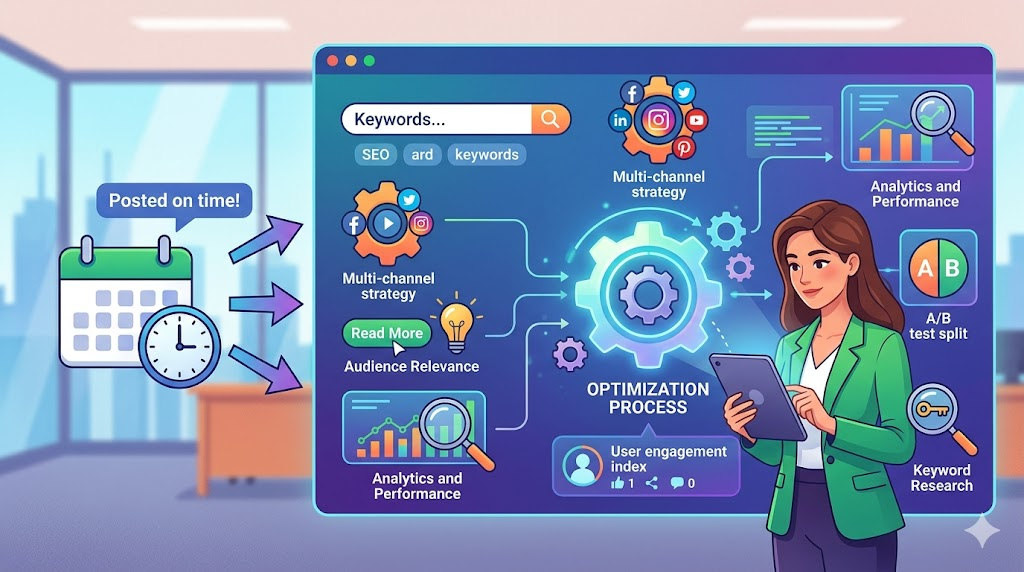
Scheduling is only one piece of the puzzle.
Successful social media marketing depends on content quality.
AI tools now assist marketers with:
Caption Creation
AI can generate caption ideas based on campaign goals, audience interests, and platform requirements.
This does not replace human creativity.
Instead, it accelerates brainstorming and helps overcome creative bottlenecks.
Hashtag Recommendations
Finding relevant hashtags can be surprisingly time-consuming.
AI tools analyze trending topics, competitor activity, and audience interests to recommend hashtags that improve discoverability.
Content Variations
Different audiences respond to different messaging styles.
AI can generate multiple versions of a caption, allowing marketers to test various approaches and identify top performers.
Tone Adjustments
A LinkedIn audience often expects a different tone than an Instagram audience.
AI can help adapt messaging while maintaining brand consistency.
The result is more relevant content across channels.
Real-World Example: Coca-Cola’s AI-Enhanced Marketing Efforts
The Coca-Cola Company has publicly discussed its growing use of AI within marketing initiatives.
The company leverages AI to support content creation, customer insights, and campaign development. These efforts help marketers identify consumer preferences and create more personalized experiences.
While AI does not replace strategic decision-making, it provides valuable information that supports stronger campaign execution.
Many brands are following a similar path.
AI acts as a co-pilot rather than a replacement for marketing expertise.
AI Reduces Manual Work for Marketing Teams
One of the biggest advantages of AI-powered scheduling is efficiency.
Many marketers spend hours each week handling repetitive tasks.
These activities may include:
- Reviewing engagement reports
- Updating content calendars
- Adjusting publishing schedules
- Monitoring performance trends
- Testing posting times
AI automates much of this work.
Instead of manually reviewing spreadsheets, marketers receive actionable recommendations.
This allows teams to focus on higher-value activities such as strategy, creative development, audience research, and campaign planning.
For growing businesses, that time savings can be substantial.
Scenario: A Local Business Expands Its Reach
Imagine a local retail company trying to increase social media engagement.
The marketing manager posts content consistently but struggles to identify the best publishing schedule.
Engagement fluctuates unpredictably.
After implementing an AI-powered scheduling platform, several patterns emerge.
The audience engages heavily between 7 PM and 9 PM.
Product videos outperform static images.
Weekend engagement exceeds weekday engagement.
The platform automatically adjusts publishing schedules based on these findings.
Within a few months, engagement improves significantly because content reaches users when they are most active.
The content itself did not change dramatically.
The timing did.
AI and Cross-Platform Optimization
Every social platform behaves differently.
What works on Instagram may fail on LinkedIn.
What performs well on Facebook may underperform on TikTok.
Managing these differences manually becomes increasingly difficult as brands expand their presence.
AI helps by analyzing platform-specific performance patterns.
Marketers can identify:
- Which content formats work best
- Optimal publishing frequencies
- Audience behavior differences
- Engagement trends by channel
This creates a more refined content strategy across platforms.
Instead of using a one-size-fits-all approach, businesses can tailor their efforts based on data.
Why Human Oversight Still Matters
AI is powerful, but it is not infallible.
Marketing remains fundamentally human.
Audiences connect with stories, emotions, experiences, and authentic communication.
AI can identify patterns, but it cannot fully understand cultural nuance, brand values, or customer sentiment in the same way humans can.
The strongest results occur when marketers combine human expertise with AI insights.
Think of AI as an advanced navigation system.
It can recommend the fastest route, but the driver still decides where to go.
Successful marketers understand this balance.
They use AI to improve efficiency while maintaining creative control.
What Businesses Should Look for in AI Scheduling Tools
Not every platform offers the same capabilities.
When evaluating AI-powered social media tools, businesses should prioritize features that align with their goals.
Important capabilities include:
- Predictive scheduling
- Audience analytics
- Performance forecasting
- Automated reporting
- Content recommendations
- Cross-platform management
- Engagement tracking
The goal is not simply automation.
The goal is smarter decision-making.
Businesses should select platforms that provide actionable insights rather than overwhelming dashboards filled with data.
The Competitive Advantage of AI-Driven Social Media Management
Social media marketing continues becoming more complex.
Algorithms evolve.
Consumer behavior shifts.
Competition increases.
Businesses that rely solely on manual processes often struggle to keep pace.
AI provides a practical solution.
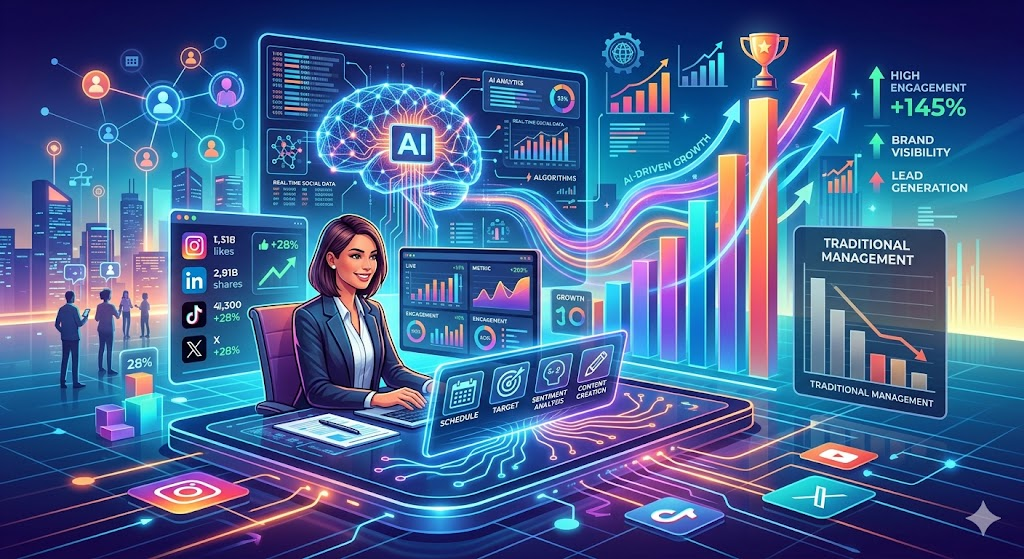
It helps marketers identify opportunities faster, optimize publishing schedules, improve content performance, and allocate resources more effectively.
For organizations seeking growth, these advantages can translate into measurable business outcomes.
This is one reason many companies now seek a digital marketing agency in Pasadena that incorporates AI-driven strategies into campaign management. Agencies that combine marketing expertise with advanced technology can often uncover opportunities that traditional approaches miss.
The value extends beyond efficiency.
It improves decision-making.
The Future of Social Media Scheduling
The next generation of AI tools will likely become even more sophisticated.
Future systems may predict emerging trends before they gain traction, recommend campaign adjustments in real time, and personalize content distribution at unprecedented levels.
We’re already seeing early signs of this shift.
As AI continues evolving, businesses will gain deeper insights into audience behavior and campaign performance.
The brands that adapt early will be better positioned to compete in increasingly crowded digital spaces.
That does not mean abandoning human creativity.
Quite the opposite.
The future belongs to marketers who use AI to enhance strategic thinking, not replace it.
When technology and human expertise work together, social media becomes more than a publishing channel.
It becomes a growth engine.
Conclusion
AI has transformed social media scheduling from a simple automation task into a strategic marketing function.
Instead of guessing when to post, marketers can rely on data-driven insights. Instead of manually reviewing endless reports, they can focus on strategy and creativity.
The benefits extend beyond convenience.
AI helps businesses improve engagement, optimize content performance, and better understand their audiences.
Most importantly, it allows marketing teams to spend less time managing processes and more time creating meaningful connections with customers.
As social platforms continue evolving, businesses that embrace AI-powered optimization will be better equipped to reach the right audience at the right moment with the right message.
Frequently Asked Questions
How does AI determine the best time to post on social media?
AI analyzes historical engagement data, audience activity patterns, geographic locations, and platform behavior to identify optimal publishing times.
Can AI improve social media engagement?
Yes. AI helps marketers publish content when audiences are most active and provides recommendations that can improve visibility and interaction rates.
Does AI replace social media managers?
No. AI supports social media managers by automating repetitive tasks and providing insights. Human creativity and strategic thinking remain essential.
What are the benefits of AI-powered social media scheduling?
Benefits include improved posting times, stronger engagement, predictive analytics, content optimization, automated reporting, and reduced manual workload.
Should small businesses use AI for social media marketing?
Absolutely. AI tools can help small businesses compete more effectively by providing insights that would otherwise require significant time and resources to uncover.
Why do marketing agencies use AI for social media management?
AI helps agencies improve campaign performance, streamline workflows, identify audience trends, and make more informed marketing decisions across multiple platforms.