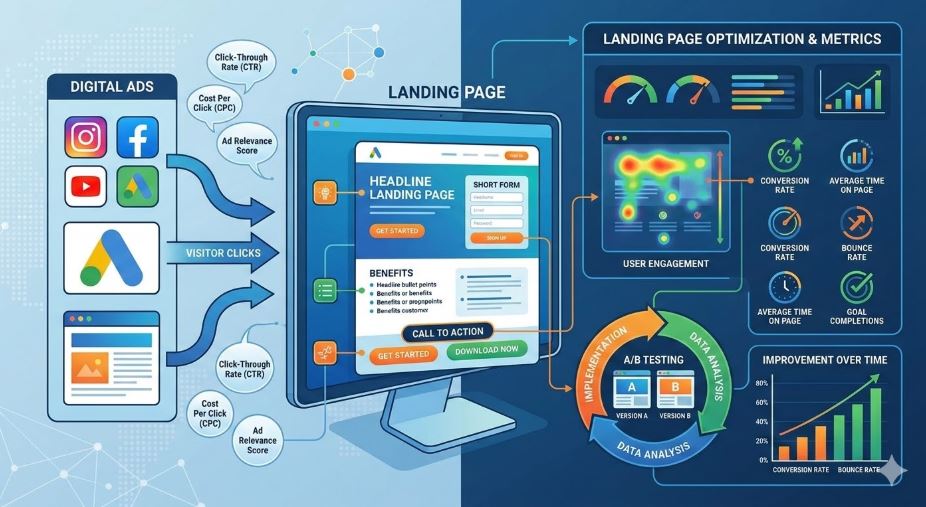
Running high-performing ads isn’t just about bidding higher or targeting the right audience. It’s about what happens after the click.
All the targeting in the world won’t make a difference if your landing page isn’t optimized for conversions. That’s why landing page optimization is a critical lever for improving ad performance.
In my years managing campaigns for businesses across industries, I’ve seen even the best ads fail because the landing page didn’t deliver a seamless, persuasive experience. Conversely, a well-optimized landing page can multiply the ROI of every ad dollar spent. Let’s explore how to make it happen.
Why Landing Pages Matter for Ads
Landing pages are more than placeholders. They are where interest turns into action.
When someone clicks an ad, they expect continuity. The messaging, imagery, and offer in your ad must align perfectly with the landing page. A mismatch confuses users and increases bounce rates.
Optimized landing pages also improve Quality Score in Google Ads, reduce cost-per-click (CPC), and boost conversion rates. In short: they make your ads more effective and your budget goes further.
What Is Landing Page Optimization?
Landing page optimization (LPO) is the process of improving page elements to increase conversions and engagement.
Key areas include:
- Page load speed – slow pages frustrate users and increase bounce rates.
- Design and layout – a clean, intuitive layout guides users toward the CTA.
- Messaging alignment – the page should reflect the promise made in the ad.
- Forms and conversion paths – easy-to-fill forms and clear steps reduce friction.
- Trust signals – testimonials, reviews, security badges, and guarantees build confidence.
Think of your landing page as a conversion machine: every element should encourage action.
Key Elements of High-Converting Landing Pages
Optimizing your landing page starts with fundamentals. Here are the elements that have the biggest impact:
Headlines That Match Ad Copy
The first thing users see is the headline. It must echo the ad they clicked.
Example: if your ad promises “Free PPC Audit,” your landing page headline should reinforce that promise. Consistency builds trust and keeps users engaged.
Compelling Calls-to-Action (CTAs)
CTAs are where conversions happen. They should be clear, concise, and action-oriented.
Instead of “Submit,” try “Get Your Free Audit Today” or “Book My Strategy Call.” Highlighting the value motivates clicks.
Visual Hierarchy and Layout
Humans scan web pages. Use headings, subheadings, bullet points, and whitespace to guide attention.
Important elements like CTAs should stand out visually. Avoid clutter that distracts from conversion goals.
Mobile Responsiveness
With over half of web traffic coming from mobile devices, your landing page must render properly on any screen.
Buttons should be tappable, forms should be easy to fill, and content should adapt seamlessly to smaller screens.
Page Load Speed
Even a two-second delay can reduce conversions. Optimize images, minimize scripts, and use reliable hosting to keep pages fast.
Trust Signals
Social proof and credibility matter. Include:
- Customer reviews
- Testimonials
- Security badges
- Case studies
These elements reduce hesitation and encourage action.
Aligning Landing Pages With Ad Campaigns
The most common mistake advertisers make is disconnecting their landing pages from their ad campaigns.
To maximize performance:
- Match ad messaging to the page headline and copy.
- Align imagery and offers.
- Ensure keywords reflect the content of the landing page.
This alignment increases relevance, reduces bounce, and improves Quality Score, which can lower CPC and improve ad placement.
Segmentation helps too. For instance, a campaign targeting first-time visitors might feature educational content, while a retargeting campaign emphasizes promotions or demos.
Personalization can further boost engagement. Showing relevant messaging based on the user’s search intent or previous behavior improves conversions significantly.
Testing and Iterating for Better Results
Landing page optimization is never a one-time effort. Testing is critical.
A/B Testing
Test variations of:
- Headlines
- CTAs
- Images
- Form placement
- Button colors
Even small tweaks can produce measurable differences in conversion rates.
Multivariate Testing
For more complex pages, test combinations of multiple elements to identify the most effective design and messaging.
Using Data to Guide Decisions
Monitor key metrics:
- CTR from ads to landing page
- Bounce rate
- Conversion rate
- Time on page
Data-driven decisions outperform guesswork every time.
Reducing Friction and Improving User Experience
High-performing landing pages remove barriers to action.
- Simplify forms: Ask only for essential information.
- Minimize distractions: Avoid unnecessary links or menus that lead users away.
- Clear visual flow: Guide users from headline to value proposition to CTA naturally.
- Consistency: Ensure fonts, colors, and design reflect your brand.
Reducing friction makes it easier for users to convert and keeps them engaged with your brand.
Advanced Optimization Strategies
Beyond basics, advanced strategies can take your landing page performance further:
Dynamic Content and Personalization
Tailor content based on:
- Visitor location
- Referral source
- Past behavior
Dynamic messaging feels more relevant, increasing engagement and conversions.
Behavioral Triggers and Smart CTAs
Use triggers like scroll depth or exit intent to display contextual CTAs, nudging users toward action at the right moment.
Analytics and Heatmaps
Tools like heatmaps show where users click, scroll, or drop off. This insight informs design tweaks and improves conversion paths.
CRM and Marketing Automation Integration
Capture leads efficiently and automate follow-ups. Integrating landing pages with email or CRM systems ensures no leads fall through the cracks.
The Role of Professional Expertise
Landing page optimization can be complex. For businesses seeking maximum ROI from paid ads, partnering with a digital marketing agency in Pasadena can make a difference.
Expert agencies bring:
- Conversion rate optimization (CRO) expertise
- UX and design insights
- A/B and multivariate testing knowledge
- Analytics-driven recommendations
This approach ensures landing pages aren’t just visually appealing but strategically designed to convert.
Common Mistakes to Avoid
Even experienced marketers sometimes overlook simple issues:
- Mismatched messaging between ad and page
- Overly long forms
- Slow-loading pages
- Missing mobile optimization
- Generic, uninspiring headlines
Fixing these common mistakes can yield quick, tangible improvements in ad performance.
Measuring Success
The impact of landing page optimization is measurable.
Key KPIs include:
- Conversion rate (CVR)
- Cost per conversion (CPC)
- Bounce rate
- Average session duration
- Return on ad spend (ROAS)
Continuous monitoring allows marketers to refine strategies, scale successful pages, and retire underperforming variations.
Conclusion: Landing Page Optimization Drives ROI
Ads bring clicks, but landing pages drive action.
When done right, landing page optimization improves:
- Conversion rates
- Ad relevance
- Quality Score
- Cost efficiency
It bridges the gap between attention and action.
Businesses that invest in landing page strategy see measurable performance improvements across campaigns. For organizations aiming to maximize ad ROI, working with a professional partner — such as a digital marketing agency in Pasadena — ensures every click has the best chance of converting.
Remember: a great ad without a great landing page is like a perfect pitch with no batter at the plate. Align your messaging, design your pages for action, test continuously, and watch your campaigns thrive.