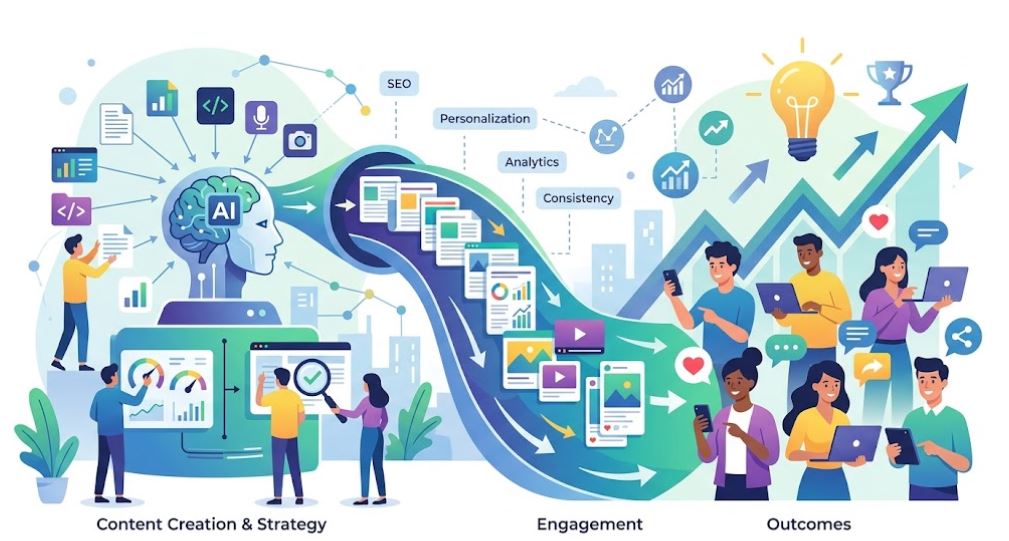
Search has changed in a way that’s hard to ignore. Content is no longer just about ranking—it’s about holding attention long enough to matter.
Marketers are now competing with faster production cycles, smarter tools, and audiences that decide in seconds whether to stay or leave. AI sits right in the middle of that shift, but not in the way most people assume.
It’s not replacing strategy. It’s forcing better ones.
The teams seeing real results are not just using AI to write faster. They’re using it to think clearer, test quicker, and refine content based on real behavior instead of guesswork.
That distinction matters more than it sounds.
Why AI Content Strategy Isn’t Just “Writing with Tools”
There’s a common misunderstanding that AI content strategy is about automation. In reality, it’s closer to structured decision-making supported by tools.
AI can help generate drafts, but it can also map patterns across search intent, content gaps, and engagement behavior. That’s where it becomes useful for marketers—not as a writer, but as an analyst.
Take Google’s evolving ranking systems as an example. The focus is increasingly on helpfulness and experience-driven content. Google’s documentation makes this clear in its SEO guidelines: Google Search Central SEO Starter Guide
What does that mean in practice? It means content that feels predictable or overly optimized tends to underperform, even if it’s technically correct.
AI becomes valuable when it helps identify what users actually care about—not just what keywords they type.
How AI Is Actually Changing Content Engagement
Engagement used to be measured by clicks and time on page. That’s still true, but the layers beneath it have become more complex.
Now, AI systems analyze patterns like:
- Scroll depth and reading behavior
- Query refinement after a click
- Content repetition across pages
- Contextual relevance across topics
This shift pushes marketers to think beyond single articles and toward content ecosystems.
A practical way to look at it: one blog post is no longer the product. The entire content journey is.
Example: E-commerce Brand Scaling Content with AI
A mid-sized e-commerce brand selling skincare products started using AI tools to cluster their content. Instead of publishing isolated blogs like “Best Moisturizers for Dry Skin,” they built interconnected pages around skin concerns, ingredients, and routines.
AI helped identify gaps such as “barrier repair routines for sensitive skin” that weren’t heavily covered by competitors.
Within four months, organic traffic increased significantly—not because they wrote more content, but because their structure made more sense to search engines and users.
The improvement came from alignment, not volume.
Where Most Teams Get AI Content Wrong
A lot of businesses adopt AI tools and expect immediate results. That’s where problems start.
The biggest mistake is treating AI output as final content instead of raw material.
AI tends to average out language. That creates content that feels safe, but also forgettable. Readers can sense when something lacks perspective or lived understanding.
Another issue is over-optimization. Some teams still write as if search engines only care about keyword placement. That approach doesn’t hold up anymore.
Even agencies struggle here. Whether it’s a startup or a 10-year old business, the pattern is the same—speed increases, but quality drops when editing is rushed or skipped.
Building a Smarter AI Content Workflow
The most effective teams don’t start with AI writing. They start with AI research.
Here’s a more grounded workflow that actually holds up in practice:
1. Start with intent mapping, not keywords
Instead of asking “What should we rank for?”, ask:
“What problem is the user actually trying to solve?”
AI tools can cluster search queries into intent groups. That helps you avoid creating redundant content.
2. Use AI for structure, not voice
Let AI suggest outlines, headings, and topic flow. But keep the voice human.
Readers connect with tone, not templates.
3. Layer human insight on top of generated drafts
This is where most of the value comes in. Add context only a practitioner would know.
For example:
- What actually works in campaigns vs. what tools suggest
- What clients usually misunderstand
- What trends are overstated in the industry
That layer is what turns generic content into trusted content.
4. Validate with real engagement signals
Instead of relying only on rankings, track:
- Which sections get read the most
- Where users drop off
- Which posts generate inquiries or leads
AI can assist here too, but interpretation still matters.
Example: SaaS Company Using AI for SEO Content
A SaaS company in the project management space started using AI to scale blog production. Initially, they focused on volume—publishing multiple posts per week.
Traffic increased slightly, but engagement stayed flat.
They changed their approach.
Instead of producing more articles, they used AI to analyze top-performing competitor content and identify structural patterns. They discovered that high-performing pages consistently included real workflow examples, not just feature explanations.
After adjusting their content strategy, they reduced output but improved engagement significantly. Readers stayed longer, and demo requests increased.
The key shift wasn’t technical. It was editorial judgment guided by AI insights.
Practical AI Content Strategies That Actually Work
Let’s bring this into something more actionable.
If you’re building a content system that uses AI effectively, focus on these areas:
Create content clusters instead of standalone posts
Search engines prefer topical depth. AI can help map related subtopics that belong together.
Refresh existing content instead of constantly creating new pages
Some of the strongest gains come from updating older posts with new insights, not writing new ones.
Use AI to simulate audience questions
Instead of guessing what readers want, prompt AI to generate likely follow-up questions. Then answer them directly in your content.
Combine AI drafting with editorial review
Never skip the human pass. It’s where clarity, tone, and trust are shaped.
Common Pitfalls in AI-Driven Content Strategies
Even experienced teams fall into predictable traps.
Over-reliance on automation
AI is efficient, but efficiency alone doesn’t create authority.
Writing for algorithms instead of people
Search systems are getting better at detecting content that feels engineered rather than helpful.
Ignoring brand voice
When every article sounds slightly generic, brand identity weakens.
Treating SEO as a checklist
SEO is not a list of tasks. It’s a feedback loop between content and user behavior.
The Role of Agencies in AI Content Strategy
Many businesses now look for partners who understand both AI tools and human-driven marketing strategy.
Working with a digital marketing agency in Pasadena or similar markets is no longer just about outsourcing content. It’s about building systems that combine data, automation, and editorial judgment.
The best agencies don’t just produce content. They design how content learns over time.
That’s a subtle but important difference.
Conclusion: AI Doesn’t Replace Strategy—It Exposes Weak Ones
AI hasn’t simplified content marketing. It has made weak strategies more visible.
If your content lacks direction, AI will produce more of it—faster. If your strategy is strong, AI amplifies it.
The real advantage comes from how well you combine tools with thinking. Not replacing one with the other.
And that’s where most of the opportunity sits right now. Not in doing more, but in building systems that make each piece of content matter a little more than the last.
FAQ
1. How does AI improve content engagement?
AI helps identify patterns in user behavior, search intent, and topic gaps. This allows marketers to create more relevant and structured content that matches audience needs.
2. Should AI write full blog posts?
AI can generate drafts, but it should not replace human editing. The best results come from combining AI output with human insight and experience.
3. Is AI content good for SEO?
Yes, if used correctly. AI content performs well when it is reviewed, refined, and aligned with user intent rather than keyword stuffing.
4. What is the biggest mistake in AI content marketing?
The most common mistake is relying too heavily on automation without adding human perspective. This leads to generic and low-engagement content.
5. Can small businesses benefit from AI content strategies?
Yes. Small teams can use AI to research topics, structure content, and scale production. The key is maintaining quality control and brand voice.